

![How to Promote Reviews In Ecommerce Marketing Campaigns [Ads + Emails]](https://cdn.prod.website-files.com/60d08d8f7ed64b84fb3552cd/62986f7f8b5415422d78d260_use-reviews-ecommerce-marketing.jpg)
Say you were out on a much-needed solo vacation across the United States.
But instead of painting an Instagram-worthy picture, let’s talk about the realities of travel for a moment.
You are hungry and you are standing by a long stretch of road.
It’s hot, it feels lonely, and you trundle on to a square where you see a couple of small restaurants run by local vendors.
Because you have health issues (and can’t eat anything, anywhere), you check out Yelp or Google reviews for local vendors (where you are).
You are likely to do what most people do: fire up Google (or Yelp), look for some quick reviews, see if you can spot the local deli, and walk right in (and might even try out their most recommended seafood platter?).
You are not alone. It happens for your customers too.
Reviews are pure Gold -- the best thing that ever happened to small businesses and eCommerce businesses. Online Reviews take the power of “Word of mouth” and dial it up several notches, at scale.
Using customer reviews in your ads and emails — social proof marketing — is one of the cheapest ways to lift conversions in ecommerce.
Below are real examples of brands promoting reviews in ads and email campaigns, why each one works, and how to steal it.
Why are Reviews Important for eCommerce?
You don’t trust the paid marketing dollars of a large brand as much as you’d trust someone else “like you” -- this is what create communities, and is why we're human beings. You’d trust your family, friends, and acquaintances first, before brand claims.
A customer review feels different from a brand statement for one simple reason: it comes from someone who used the product.
Someone like you and me.
Someone we can relate to.
But the star itself rating is not the useful part.
The useful part is the detail: the context, a real situation, with the exact same product.
A specific outcome the next buyer can judge and relate to.
That does not mean every review works in every campaign.
A vague five-star quote is still decoration: a specific, verifiable review can answer a real buying doubt.
This is what we call "Social proof marketing": the practice of showing real customer reviews, ratings, testimonials and user-generated content in your ads, emails and landing pages so new potential customers will trust you, faster (and will convert faster too of course).
Instead of trusting only the brand making the claim, a customer does the promotion it for you.
In ecommerce it's one of the highest-ROI angles because shoppers trust people "like them" more than any ad.
So, before anything, you must ask yourself: what does the buyer need to believe?
First, ask customers for reviews (you'll need them)
You should have reviews already, of course, because you can't promote reviews you don't have.
The fastest ways to collect them:
- If it's really the first time - ask your friends and your best clients already.,
- Send a review-request email 5, 10 and 30 days after delivery, once the product's been used - the sooner after the first experience with the product is usually the ABSOLUTE best time to ask for a review -- it's where you'll get the highest ratings.
- Ask one specific question ("How's the fit?") instead of a generic "Leave a review": pick the question so you know you'll get the highest % of 5 stars reviews.
- Offer a tiny incentive — loyalty points or a discount on the next order is usually welcomed and helps gather more reviews.
- Make it one click: deep-link straight to the review form (pre-filled with the product or not).
- Make it easy: if you prefer to ask reviews for the whole shipping experience, you can do so too.
Follow up 2/3 times - one reminder roughly doubles responses, then you can continue to gather more reviews later, if you know people would still say positive things after a long time (+30 days).
Marketing Examples Of Using Reviews In Ads and Emails
Want to see how it looks when you use user generated content -- such as reviews -- for your eCommerce ads and email campaigns? It’s one of the most powerful advertising angles you’d take.
First, to show that this is historically one of the best way to create a marketing campaign. Gary Halbert -- one of the greatest copywriters ever, in his popular book The Boron Letters -- has nuggets of gold (if you’d like to understand how to write to make millions or more, to understand consumer behavior, or to just watch pure genius at work) -- has several examples of ads that went on to make millions of dollars for businesses then.
I, however, wanted to show you one specific ad titled: “Amazing New Formula From Beverly Hills Lets You Look Years Younger”

See what Gary does, right at the beginning of the ad (left section, highlighted)?
Uses testimonials from previous users of the product -- this is on top of the bold “Top Hollywood Stars Absolutely Love it”.
See how reviews work? Do you see how they instantly put the spotlight on your products? This is nothing new, of course.
For generations now, it’s reviews, others’ inputs, casual breakfast conversations, water cooler discussions, or a casual “Internet browsing thing” done (in various forms) that’ve always influenced our buying decisions.
Use what others say in your ads, and you don’t have to worry about “copywriting” at all. Just use the power of reviews in your ads and emails.
Customer language can make your copy more specific. You still need a clear offer, enough context, and a next step.
Here are a few examples of reviews and testimonials used in eCommerce ads.
These examples show several ways to use customer proof.
Treat each one as a creative hypothesis, then test it against your current ad or email.
Purple: Reviews in Ad as a eCommerce Mattress Brand
Purple is an eCommerce store that sells beddings, mattresses, pillows, seat cushions, bed frames, and more.
On top of all the eCommerce marketing best practices that the eCommerce business practices, here’s what I like about this recent advertising campaign by Purple.

- The complete ad copy is a simple testimonial/review and a 5-star rating by a previous customer “Nothing but pure sleeping bliss” ~ Patrick H.
- Short-form ad copy, hitting at exactly what matters to you for much-needed sleep.
- An image that shows not only an actual image of a person but also the product being used.
Why it works: A single 5-star quote as the whole ad copy removes the "is this hype?" doubt before the reader even reaches the product. Use your best review verbatim as the headline. Short, specific, signed with a first name + initial.
Skims: Reviews as a Fashion eCommerce brand
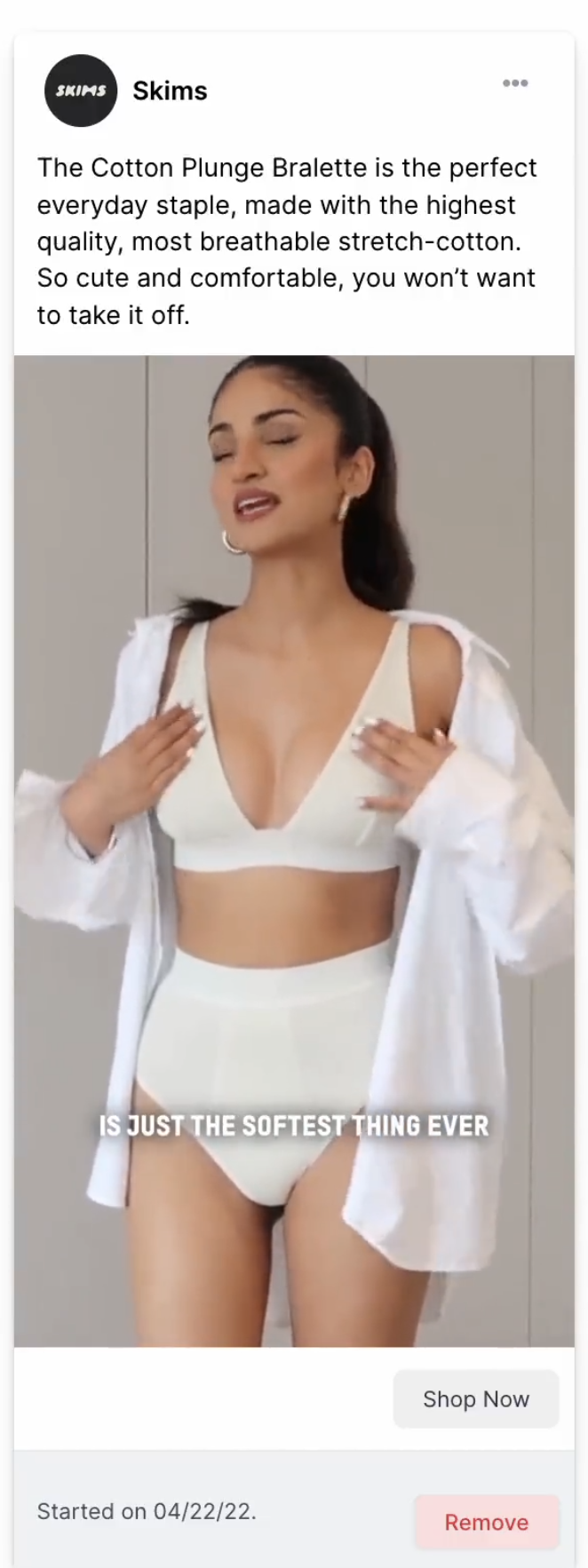
- Did you know that “#FoundOnAmazon” is a popular hashtag --it’s popular because people love it when others actually buy and recommend products. This Ad campaign from Skims featuring their Cotton Plunge Bralette makes use of a real person “talking” about their product. Absolute winner.
- We think it’d get even better if they start with "A friend recommended..." or "I've read thousands of reviews" or "Tiktok made my buy it"”
Why it works: "#FoundOnAmazon" borrows a real customer's voice, so it reads as a recommendation, not an ad. Open the ad with "A friend recommended…" or "TikTok made me buy it" to frame it as peer proof.
WildRefill: A Deodorant & Wellness brand, suing reviews in Ads
How about not just “talking” about a product but actually having the confidence to use a product in front of a camera? Even more powerful, if you ask us (plays nice with a few products: like deodorants, perfumes, electronics, and so on).
That’s exactly what WildRefill does with this campaign (along with a few other best practices)
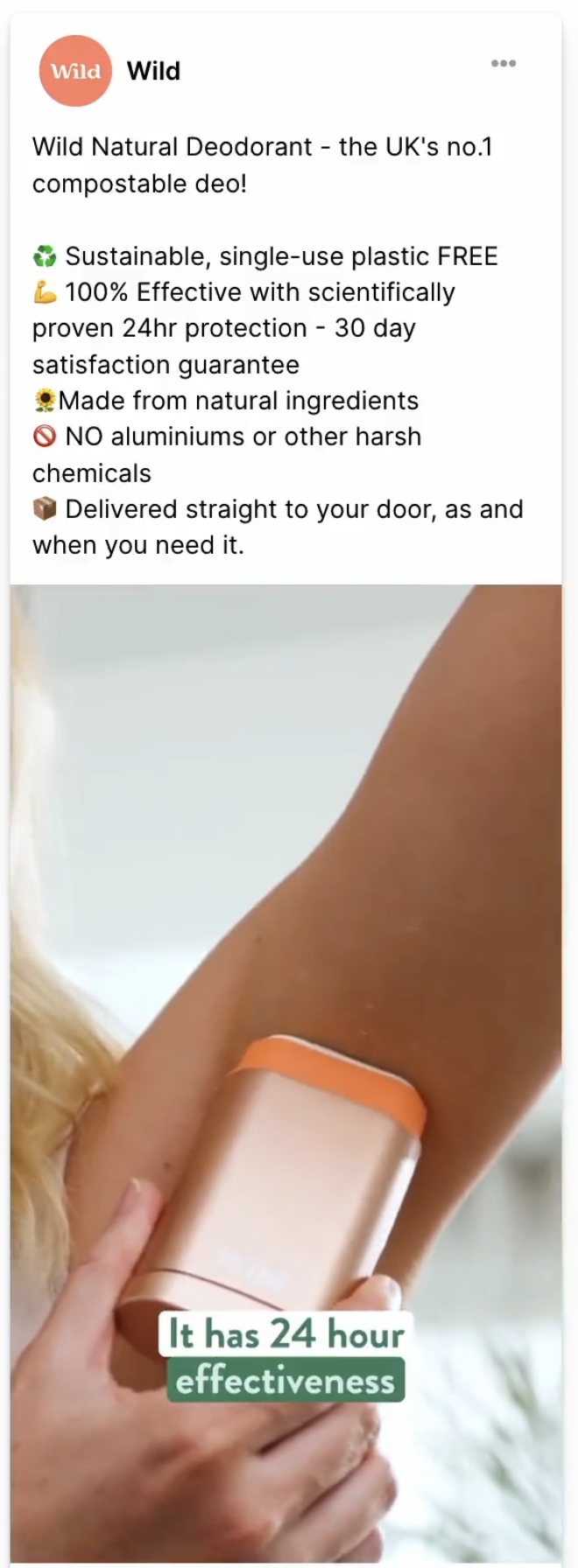
- A real person talking about WildRefill’s Wild Natural Deodorant -- the lady in the ad actually puts on the deodorant, on camera.
- Use of emojis is well-done.
- Phrases like 100% effective, delivered straight to your door, no harsh chemicals, and that No.1 In UK -- they all help, of course.
Why it works: A real person using the product on camera is proof you can't fake — perfect for deodorant, skincare, electronics. Film a 15-second demo where a customer actually uses the product, with plain on-screen claims (no harsh chemicals, No.1 in UK).
Native Flow’s Welcome Email in using Reviews to introduce the brand
Welcome emails are powerful not only for what they do but they also have benefits as far as branding, first impressions, effective onboarding, and more.
This welcome email from Native is a gem. Take a look:

- Glowing testimonials, 5-star reviews, and using the power of “word of mouth” or its digital equivalent never gets old.
- Native uses several testimonials within the welcome email
- The use of product images, right next to testimonials, is a neat touch
Why it works: New subscribers don't trust you yet — stacking testimonials in email #1 borrows trust immediately. Put 2–3 short reviews (with product images beside them) into your welcome email's second block.
A Email in your Welcome Flow should feature reviews
Here are a few more exemples for you to see - if you haven't implemented this now, you should!
Why it works: Reviews inside the welcome flow prove it works: it's the highest-intent moment you're wasting.


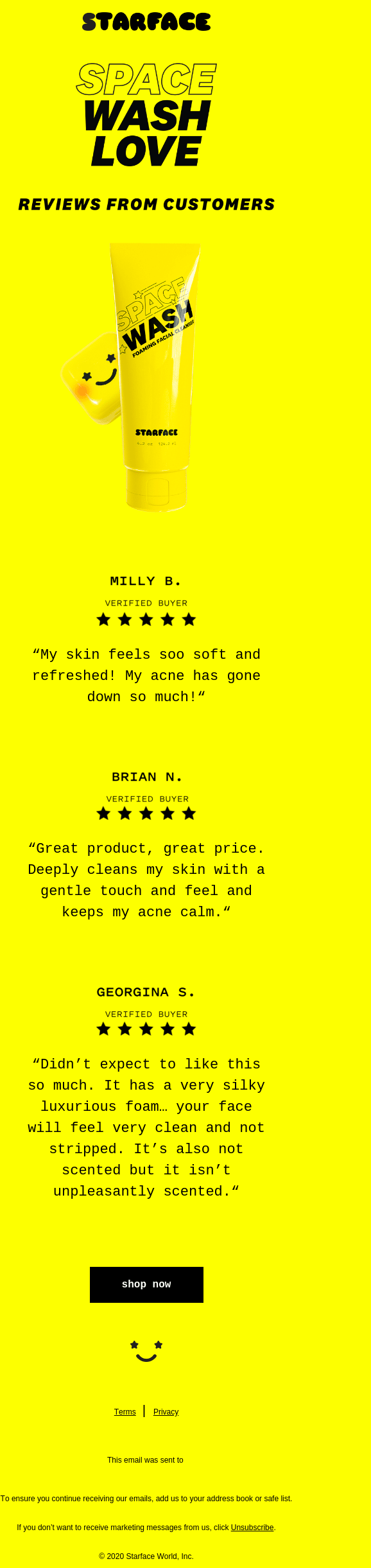
BriogeoHair’s New Product Launch Email
Continuing with the tradition of showcasing reviews, testimonials, and the “good word” inside promotional campaigns, see what BriogeoHair’s email sequence looks like.
Why it works: A product launch is a "why should I care?" moment; a Teen Vogue mention + stacked testimonials answers it instantly. In launch emails, place press mentions and reviews directly under the hero image, one below the other.

- The use of the header space within the email with product images is classic.
- Testimonials, neatly laid out -- one below the other. You won’t miss those, even if you tried.
- The testimonial from TeenVogue -- let’s new (and old) customers know that they are getting noticed.
Use Reviews when Launching a Product
Here are a few more examples:
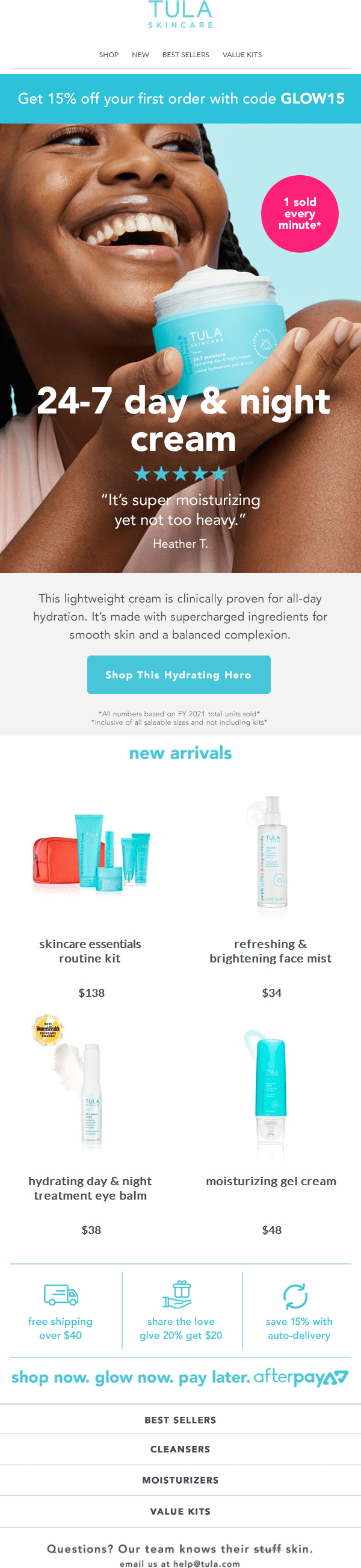

Here are our favourites emails featuring reviews
Ohne specializes in cycle care for ladies who bleed (calling them “babes”) with 100% organic cotton, biodegradable period products. Ohne has their brand insignia and the tone of voice within their emails as well.
Why it works: Before/after photos from real users are the strongest review format there is — the proof is visual. Ask customers for before/after photos and lay them out as an email header collage.
Take a look:

- The images (in the form of a collage) as an email header? Nice touch
- The brand’s tone continues unfiltered in the email -- as it were, from their users in their own voices.
- Before and after pictures, from users themselves. It doesn’t get better than that.
Also, notice this one from Glossier.com:
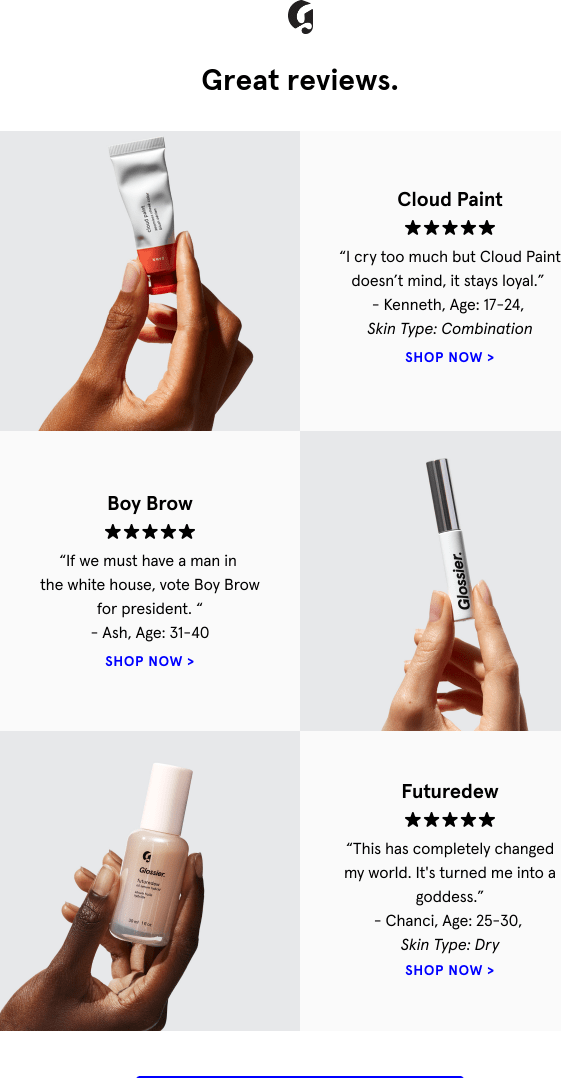
See our curated list of brands and campaigns that promote reviews in marketing campaigns (including ads and emails).
Use reviews and testimonial-driven email campaigns as a way create:
- A strong and captivating lead to a story that you’ll write in your ads or emails.
- Human-driven stories for ads.
- An incredibly effective way to personalize your ads, emails, and landing page copy (as long as you are targeting the right audience)
How do you use reviews in your ads and email marketing campaigns? Do you use user generated content as inputs for your ads or email marketing campaigns?
If you’d like to power up your email campaigns and make your ad campaigns more effective, learn from some of the best brands that make their campaigns work to push up revenues and profits.
Get inspiration, curate campaigns, and benchmark your own campaigns against the best campaigns in eCommerce by using Panoramata.
How to gather the right reviews for the right campaign?
As we've said in the beginning, write the one buyer doubt this campaign needs to answer.
Then, choose a real review that answers that doubt in the customer's own words.
To make sure this is clear to your audience, add the missing context: product, use case, etc.
Here's my advice: build two versions. Once you have the first one, change only the context in the variant: maybe some part of your audience would better relate to this review under different situations.
When launching (whether it's email or ads), it's always important to setup a goal. Pick the decision metric before launch: CTR, ROAS, etc.
Here's a useful brief for a social proof campaign, if needed:
- Campaign and channel: Emails, ads, etc.
- Audience: New users, repeat customers, etc.
- One buyer doubt: Price/Benefits/etc.
- Exact review:
- Why this review answers the doubt:
- Situation control:
- Situation variant:
- Primary decision metric:
FAQ
How do you promote reviews in ads and emails?
Put the review where the eye lands first: a 5-star quote as ad copy (like Purple), a real customer on camera (like Wild), or a stack of testimonials in a welcome or launch email (like Native and BriogeoHair).
How do you ask customers for a review?
Email them 5–10 days after delivery, ask one specific question, make it one click, and follow up at least once. A small loyalty incentive increases response rates (and is welcomed, and it helps your retention too).


