

Should you go viral?
We all had this need to jump on the current viral trend, thinking it might have a huge impact.
But, before chasing every viral trend, ask yourself first , “is this a real opportunity or just a moment of noise?”
A viral trend you’re riding at the right time is a great thing.
It’s also short-term thinking, except if you’re able to turn this into a system.
What you should do instead, is look for patterns, consistent messaging, campaigns across multiple channels, and ongoing investment.
You don't have to react to every spike: in fact, if you do, you'll just react to sometimes meaningful changes, but most of the time, it will be irrelevant and won't help you drive any growth. You'll just lose time and momentum. And we don't want this!
So, let’s do this together.
How to identify real marketing opportunities from competitors
You should listen to signals that repeat, not just moments that trend.
Your competitor blew up.
Good for him.
That doesn’t mean they won.
A competitor launches a flashy campaign.
It racks up engagement.
It floods your feed.
We all have the same thought: “Why aren’t we doing this?”
And suddenly, strategy becomes a reaction.
But here’s the uncomfortable truth:
Not every viral campaign is an opportunity. Some are just noise.
The Engagement Illusion
It’s easy to fall into the trap:
See a trend → Assume it’s working → Copy it → Hope for the same results.
Visibility is not impact.
Engagement is not just a whole lot amount of views. They could be bought, or irrelevant to the target audience.
True engagement is when the target audience actually remembers (likes, saves, etc.) your content.
And, at the end of the day, when a small subset converts, which should be your goal.
Even then, the numbers are usually smaller than people think.
Even high-performing posts rarely exceed 3 or 4% consistently. To put it in perspective, a post reaching 100,000 people may engage fewer than 3,000, and only 2 of clicks convert.
So yes, a campaign can look huge. And still do very little.
So, what looks like reach or "viral" success is often amplified by ad spend, not organic resonance.
Without context, chasing trends may feel productive, but it rarely delivers meaningful results, as engagement reflects real connection, not just numbers on a screen.
But what if going viral is actually working for them?
Fair question.
Yes, some viral campaigns do succeed.
They can redefine brand perception, drive growth, and even open new acquisition channels.
Viral success happens, and it can be real.
The challenge isn’t noticing it, it is reacting too quickly. A single spike doesn’t tell the full story because true business impact leaves patterns, not just one-off moments:
- Repetition over time
- Expansion across multiple channel
- Increased of budget allocation
- Message refinement, not reinvention
- Integration into long-term positioning
Real opportunities create these patterns because growth leaves evidence.
Sustained behavior is strategy, a single spike is often just experimentation.
Most teams respond to the moment instead of waiting for these signals, but understanding the patterns is what separates reactive moves from strategic decisions.
The cost of reactive marketing
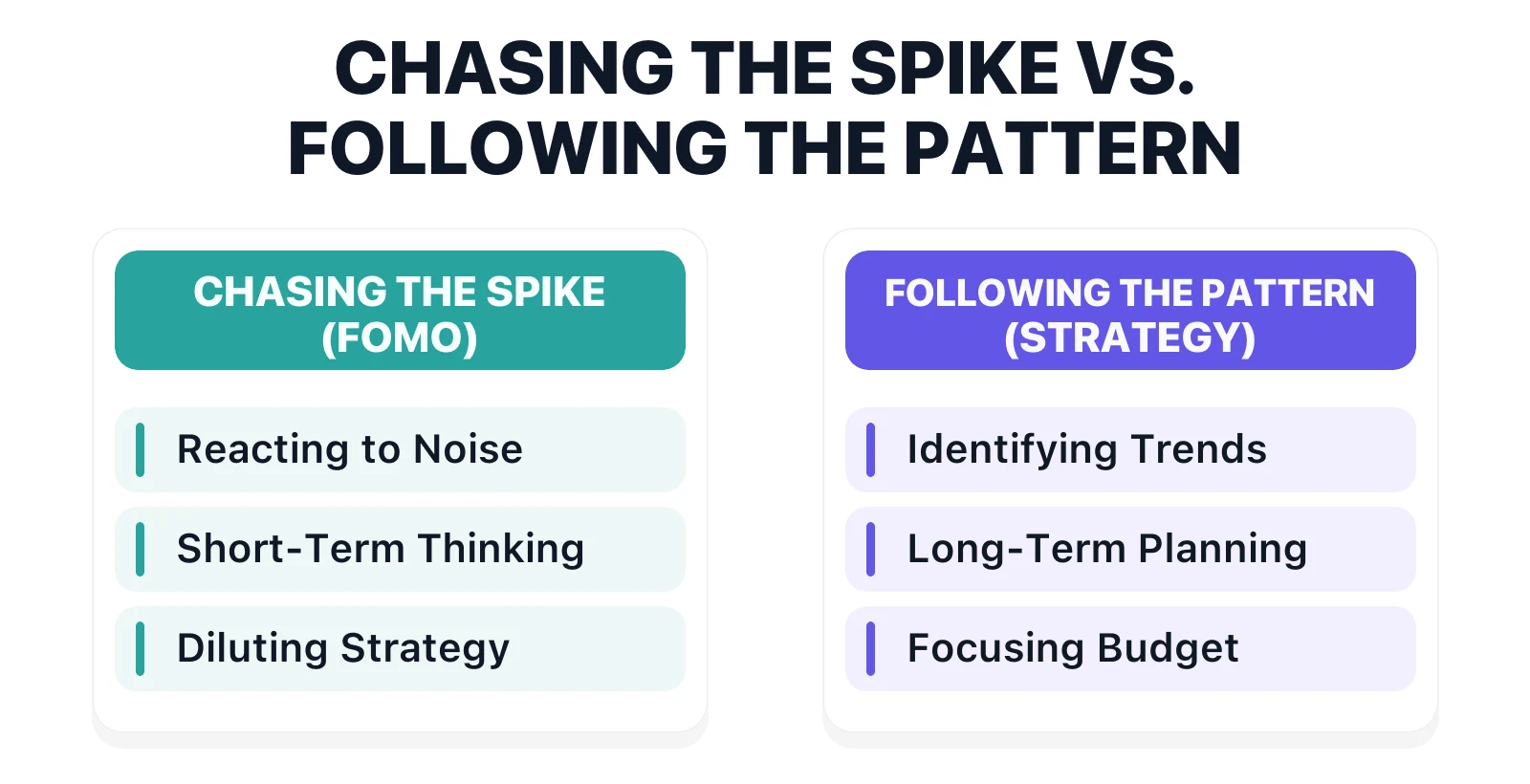
When companies chase surface-level success without context, they risk:
- Diluting positioning
- Confusing audiences
- Misallocating budget
- Distracting teams from long-term initiatives
Worse, they begin measuring visibility instead of impact. That’s not innovation. That’s FOMO disguised as strategy.
What data-driven teams do differently
Instead of asking, “Is this trending?”
They ask:
- Has this competitor doubled down on this message?
- Are they executing across paid, organic, and owned channels?
- Has it persisted over time?
- Is it aligned with a broader strategic shift?
Because sustained behavior reveals intent. And intent reveals opportunity.
Why Full-Picture Competitive Insight Matters
Surface-level visibility is easy. Strategic visibility is rare.
At Panoramata, we help marketing teams move beyond vanity metrics and into strategic clarity, tracking competitor behavior across channels and over time, so you can identify real opportunities instead of reacting to hype.
Because:
- Clarity beats noise.
- Patterns beat spikes.
- Strategy beats FOMO.
Always remember that the loudest signal in the room isn’t always the most valuable one. The smartest teams don’t copy what’s visible. They understand what’s durable.


