

By the time Thanksgiving arrives, your customers have probably already seen plenty of holiday emails.
Some brands are teasing Black Friday. Others are already offering discounts. Some are pushing gift guides, early access, free shipping, or “biggest sale of the year” promotions.
And then there’s Thanksgiving.
It can easily get swallowed up by everything happening around it.
That’s the problem with Thanksgiving email marketing. The holiday sits right before Black Friday, so it’s tempting to use the day as one more reason to sell.
But Thanksgiving doesn’t have to compete with Black Friday.
In fact, your Thanksgiving email can work because it doesn’t sound like Black Friday.
Instead of asking what discount you should send, start by asking a different question:
What should this email do that your Black Friday emails don’t?
That one question can completely change how you build the campaign.
Thanksgiving and Black Friday have different jobs
Black Friday is naturally about shopping.
People are looking for deals, comparing products, checking wish lists, and deciding whether something is worth buying. That’s why Black Friday emails tend to be direct. “50% off.” “Ends tonight.” “Shop now.” “Last chance.”
Thanksgiving doesn’t need to sound like that.
It can be the quieter part of your holiday campaign.
You can use it to thank customers, share something useful, give a small perk, tell a story, or simply remind people why they signed up for your emails in the first place.
Then, when Black Friday arrives, you can turn the sales message up.
This gives each email a reason to exist instead of making every message fight for attention with the same discount.
And with Black Friday email volume already being extremely competitive, creating a clear difference between your Thanksgiving and Black Friday messaging can help your campaign feel less repetitive.
Think of your holiday campaign as three different conversations
Here’s a simple way to plan it:
Thanksgiving: “We appreciate you.”
Black Friday: “Here’s what we have for you.”
Cyber Monday: “If you’ve been waiting, now’s the time.”
They can all be part of the same campaign, but they don’t all need to sound the same.
Thanksgiving can be the more personal part of the campaign. Use it to thank your customers, share something useful, or give them a little something before the shopping rush really starts.
Then, when Black Friday arrives, you can switch gears and focus on the sale.
Cyber Monday can be your final reminder for people who were interested but didn't buy yet.
The emails are connected, but each one has a different job. Thanksgiving builds the relationship, Black Friday brings the offer, and Cyber Monday gives people one last reason to act.
Once you look at the campaign this way, it becomes much easier to decide what to say in each email without making Thanksgiving feel like another Black Friday sale.
10 Steps to Build a Thanksgiving Email Campaign
Decide what Thanksgiving is going to do
Before writing your subject line or choosing a Thanksgiving graphic, decide what role you want the email to play.
Ask yourself:
Do I want to thank people?
Do I want to give them something useful?
Do I want to reward loyal customers?
Do I want to build anticipation for Black Friday?
Do I actually want to sell something today?
All of these can work.
The problem starts when one email tries to do all five.
You might end up with a message that starts with “Happy Thanksgiving,” moves into a customer appreciation story, introduces a 30% discount, shows 12 products, teases Black Friday, promotes free shipping, and finishes with a countdown.
At that point, the reader has no idea what they’re supposed to pay attention to.
Pick one main job.
Everything else should support it.
Give Thanksgiving its own message
If you want your Thanksgiving email to feel different from Black Friday, don't just change the subject line.
Change the reason for sending it.
For example, instead of:
“THANKSGIVING SALE — 30% OFF EVERYTHING”
you could send:
“Before the holiday weekend gets busy, we just wanted to say thank you.”
Then actually say something meaningful.
Maybe your business had a big year.
Maybe customers helped you launch something new.
Maybe you've been around for ten years.
Maybe you received thousands of orders.
Maybe customers left reviews that made your team smile.
Maybe you simply want to thank people for choosing you.
It doesn't have to be dramatic.
A small, honest detail can make the message feel much more real.
“This year, you helped us reach our biggest month yet. We’re incredibly grateful for every order, review, recommendation, and message. So before the holiday weekend gets busy, we just wanted to say thanks.”
That is a Thanksgiving email.
It doesn't need a 40% discount underneath it.
For example,
Subject line: My number one fan 🥺
Sent by: The Tallowed Truth
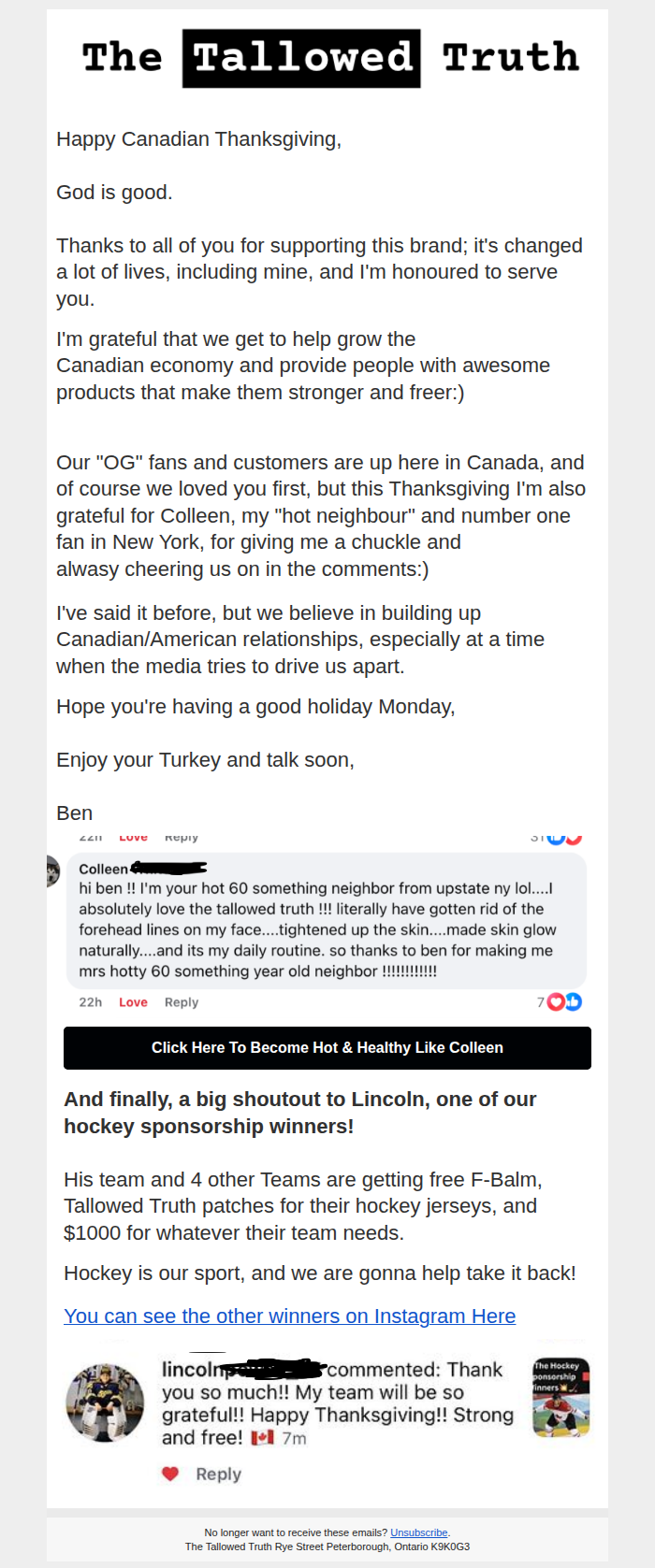
The Tallowed Truth, a brand that sells tallow-based skincare and personal care products, takes a more personal approach to its Canadian Thanksgiving email. Instead of promoting a big sale, the founder, Ben, starts by thanking customers for supporting the brand and sharing how much their support means to him.
What makes the email stand out is the personal touch. Ben gives a shoutout to one of the brand's biggest fans, Colleen, and shares how she always cheers the brand on in the comments. He also talks about what he's grateful for as a business owner and ends with a friendly holiday message.
It's not the usual polished holiday campaign filled with product images and discounts. It feels more like the founder is talking directly to his customers, which makes the message feel genuine and gives people a reason to feel connected to the brand.
Takeaway: You don't need a fancy email or a big promotion to make Thanksgiving feel special. Share something real, thank your customers, or give a shoutout to the people who support your brand. Sometimes, a personal message can do more to build a relationship than another sales email.
If you sell, give the offer a Thanksgiving reason
This doesn't mean you have to avoid promotions.
Some brands genuinely need to sell during Thanksgiving weekend.
That's completely fine.
The trick is to give the offer a reason that fits the day.
Instead of making the entire message about “SALE,” think about what you're giving back.
For example:
“A little thank-you from us: free shipping all weekend.”
“We're thankful for you, so here's 20% off your next order.”
“Our Thanksgiving gift to you: a free sample with every order.”
The promotion is still there.
You're just giving it a little more context.
And that context matters because otherwise, you could remove the word “Thanksgiving” from the email and nothing would change.
That’s usually a good test:
If the email could have been sent on any random Tuesday, it probably isn't doing enough with the holiday.
For example:
Subject line: A Thanksgiving treat for your skin 🍁
Sent by: YesStyle
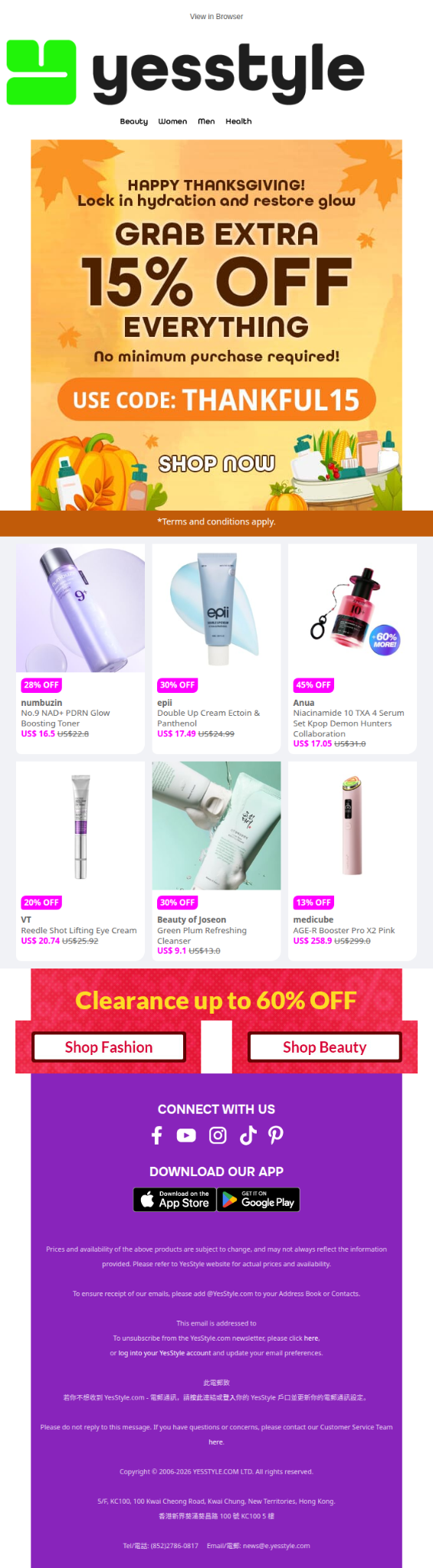
YesStyle sells Asian beauty, skincare, and fashion products. For Thanksgiving, the brand wishes its customers a happy holiday and offers an extra 15% off everything with the code THANKFUL15. There's no minimum purchase, either.
After sharing the offer, the email shows products customers can shop at a discount. It's a simple way to give people a reason to treat themselves while keeping the promotion relevant to the brand's products.
Takeaway: Discounts work for Thanksgiving, too! Just give customers a reason to care. A holiday offer, free shipping, or a little extra for shoppers can make the promotion feel more thoughtful than another random sale.
Give people something they can actually use
Here's another way to make Thanksgiving feel different from Black Friday:
Give before you ask.
Think about what your customers are doing around Thanksgiving.
They're cooking.
They're traveling.
They're visiting family.
They're relaxing.
They're shopping.
They're getting ready for the rest of the holiday season.
Your email can help with one of those things.
A food brand could send a recipe.
A clothing brand could put together easy Thanksgiving outfit ideas.
A home brand could share a quick hosting checklist.
A travel brand could send holiday travel tips.
A beauty brand could share a simple “getting ready for Thanksgiving dinner” routine.
A furniture brand could share tips for making a guest room more comfortable.
And yes, you can still include products. Just let the content lead.
Instead of:
“BUY OUR PRODUCTS FOR THANKSGIVING.”
it's:
“Here's something that might make Thanksgiving a little easier. And if you need anything for it, we've picked a few of our favorites below.”
That feels much less like a sales pitch.
For example,
Subject line: Getting sick 900 miles from home
Sent by: 4Patriots
4Patriots sells emergency and survival supplies, and its Thanksgiving email shows how these products can come in handy during holiday travel.
The email tells a story about getting sick while traveling 900 miles from home, only to find that the nearest pharmacy is closed. It then introduces the brand's $299 Emergency Medicine Kit as something travelers can prepare ahead of time.
Instead of simply showing the product and asking people to buy it, 4Patriots gives readers a situation they can picture themselves in. It helps them understand why having a medical kit on hand could be useful when traveling for the holidays.
Takeaway: Don't just tell people to buy your product. Show them how it could help during Thanksgiving. When customers can see why they might need something, the offer becomes more relevant than a discount alone.
Use Thanksgiving to reward people who already like you
Not every customer needs the same email.
If someone has bought from you several times, you have a relationship with them already.
Thanksgiving is a good excuse to acknowledge that.
You could give loyal customers:
- Early access
- A small discount
- Free shipping
- A free gift
- Store credit
- A special bundle
- First access to your Black Friday sale
But here's the important part:
Frame it as a reward, not just another promotion.
Compare:
“BLACK FRIDAY EARLY ACCESS — 40% OFF.”
with:
“You've been with us for a while, so we're letting you in first.”
Same basic tactic.
Completely different feeling.
Early access is already a common BFCM strategy, but positioning it as a genuine thank-you gives the Thanksgiving email its own purpose instead of making it another generic Black Friday teaser.
For example,
Subject line: Thanksgiving Sale Early Access
Sent by: HIDES Leather Co.
HIDES Leather Co. gives its customers a head start on its Canadian Thanksgiving sale. In the email, founder Umair tells Claudine she can shop a day before everyone else and get an extra 40% off her order, plus a free matching gift with every purchase.
What makes this email a good example is that the brand makes the customer feel appreciated. The offer isn't just about getting people to shop; it gives existing customers early access as a small thank-you for supporting the brand. The message even reminds them that the sale opens to everyone else the following day, giving them a reason to shop early.
Takeaway: Give your existing customers a little something extra before opening the offer to everyone else. Early access, an exclusive discount, or a free gift can make them feel appreciated while giving them a reason to shop.
Don't be afraid to send a Thanksgiving email with no sale
This might be the hardest part for marketers.
You may look at the calendar and think:
“We're already sending an email. We need to make money from it.”
Not necessarily.
A Thanksgiving email can simply keep the relationship warm.
You can send a short note from the founder.
Share a photo of the team.
Talk about something the company is grateful for.
Thank customers for supporting a small business.
Share a customer story.
Ask people what they're thankful for.
Or just wish them a happy Thanksgiving.
The email doesn't have to generate an order that day to be useful.
You're also building the relationship that makes the next email easier to send.
And that next email might be your Black Friday promotion.
For example,
Subject line: A Warm Thanksgiving Wish 🍂
Sent by: Sandals
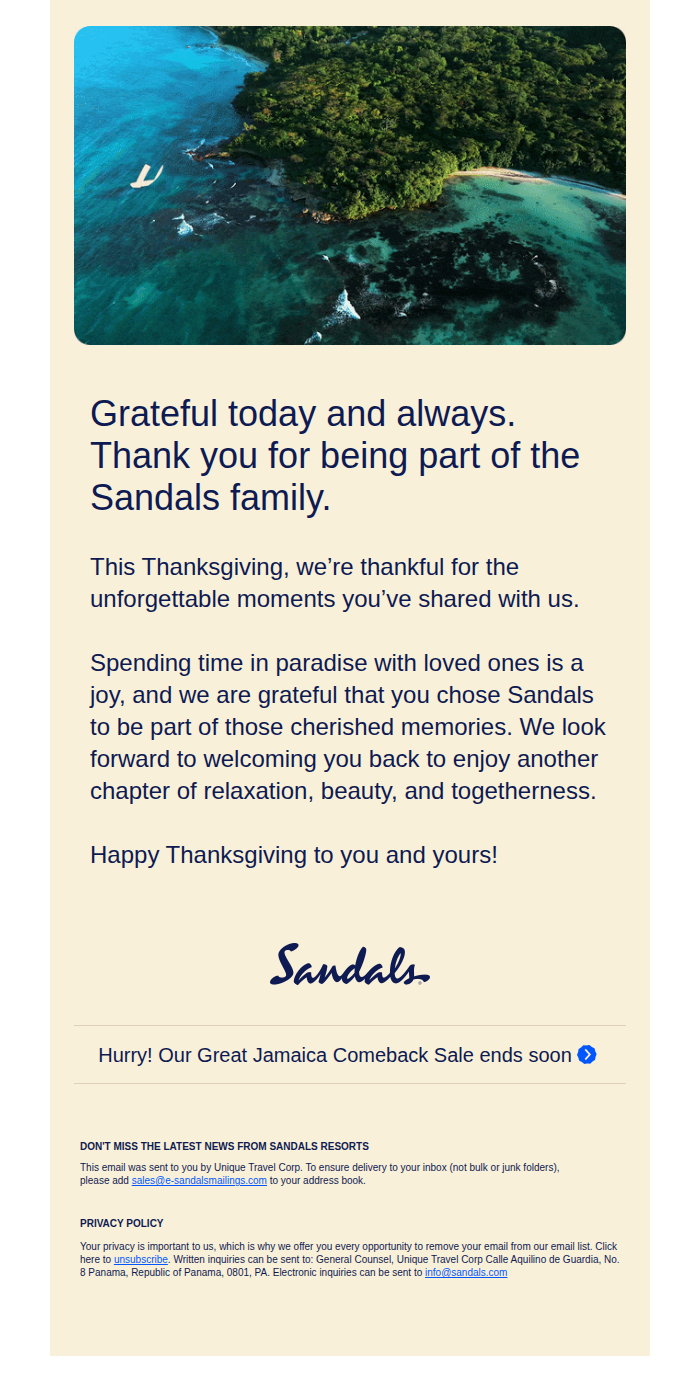
Sandals, a luxury resort brand known for its all-inclusive Caribbean getaways, takes a more personal approach to Thanksgiving. Instead of opening with a discount or asking customers to book their next vacation, the brand starts by thanking them for being part of the Sandals family.
The email reflects on the memories customers have made at its resorts and expresses gratitude for being part of those special moments. It also wishes them a happy Thanksgiving before showing links to its ongoing travel promotions further down.
What makes this a good example is that the brand gives its Thanksgiving message room to stand on its own. The sales promotions are still there, but they don't take away from the main purpose of the email: making customers feel appreciated.
Takeaway: Your Thanksgiving email doesn't always need to push a sale. Sometimes, a genuine thank-you is enough. You can still include links to your products or promotions, but let the message of appreciation take the lead.
Let the design slow down too
If your Black Friday email is going to be packed with products, prices, buttons, banners, and countdowns, make your Thanksgiving email look different.
It doesn't have to be covered in turkeys and pumpkins.
Actually, please don't feel like it has to be.
A simple photo of your team.
A handwritten-style note.
One good product photo.
A founder video.
A customer photo.
A clean text-based email.
Sometimes a simple design makes the message feel more personal.
Think about the difference between opening an email that looks like a digital billboard and opening one that feels like someone sat down and wrote you a note.
For Thanksgiving, the second one can work really well.
For example,
Subject line: A Note From Our Co-founders Before Thanksgiving 🤎🍂
Sent by: Mave & Chez
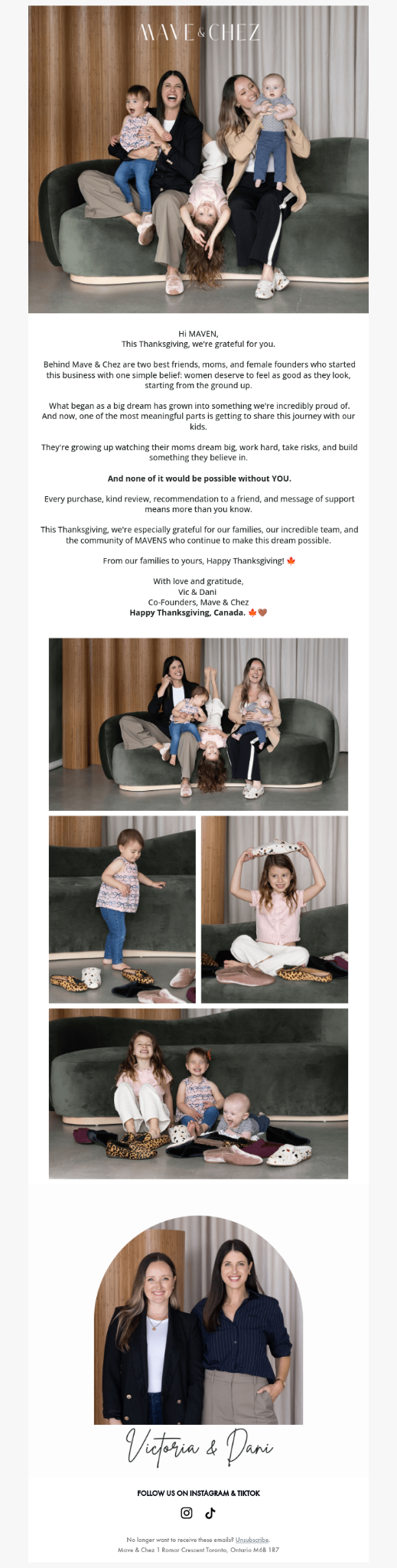
Mave & Chez, a brand built around helping women feel good from the ground up, takes a softer approach to its Thanksgiving email. Instead of filling the message with product photos, sale banners, and bold promotional graphics, the brand leads with a photo of its co-founders and a personal Thanksgiving note.
The design gives the message room to breathe. The founders share a little about their journey as best friends, moms, and business owners, then thank customers for every purchase, review, and recommendation. With the founders' photo and the heartfelt letter taking center stage, the email feels more like a personal note than another marketing campaign.
It's a good reminder that holiday email design doesn't always need to be elaborate to get attention. Sometimes, keeping things simple helps the message feel more genuine and gives readers a moment to slow down amid all the Black Friday promotions.
Takeaway: Let your design match the message. For a Thanksgiving email focused on gratitude, try a simple layout, a meaningful photo, and enough white space for your words to stand out. You don't need flashy graphics or a wall of products to make an impression.
Give the customer one thing to do
Even if your email isn't heavily promotional, don't make the reader wonder what happens next.
But the CTA doesn't always have to be:
SHOP NOW
It could be:
Read the recipe
Watch our video
Meet the team
Get your free guide
Reply and tell us
See your early access
Send a gift
Shop the collection
Or, if it's simply a thank-you email, you might not need a CTA at all.
That's okay too.
The important thing is to match the CTA to the actual purpose of the email.
For example,
Subject line: Your 8-week head start
Sent by: Epicured

Epicured offers meals and programs designed for people with digestive sensitivities, and this email gives readers a reason to think ahead before Thanksgiving dinner.
The email offers 40% off the first box of its eight-week FODMAP program, with the message “No more guessing at the Thanksgiving table.” The idea is simple: instead of waiting until the holiday meal to figure out which foods work for them, readers can start learning about their food triggers ahead of time.
I also like how the email keeps things straightforward. It explains why the program might be useful, then gives readers one clear next step: “See how it works.” There's no need to overcomplicate the message when the offer and the CTA already work together.
Takeaway: Don't leave readers wondering what to do next. Explain the benefit, keep your message focused, and give them one clear action to take.
Build the Black Friday transition instead of suddenly switching gears
This is where Thanksgiving can become really useful in your overall campaign.
Let's say your Thanksgiving email is about appreciation.
You could end with:
“Enjoy the long weekend. We'll be back tomorrow with something we've been working on for a while.”
Now Black Friday has a natural opening.
Or maybe your Thanksgiving email gives customers early access:
“Because you're part of our community, you can shop the sale a little earlier.”
Then Black Friday becomes the bigger public launch.
The two emails feel connected.
You're not suddenly going from:
“We're thankful for you ❤️”
to five hours later:
“BUY NOW! 50% OFF!”
There's a bridge between them.
That bridge is what makes the campaign feel intentional.
Subject line: Your Early Access Pass: Up to 50% Off Select Styles
Sent by: AG Jeans

AG Jeans, a premium denim and fashion brand, uses Thanksgiving as an opportunity to give its customers early access to its Black Friday sale.
The email presents the offer as a Thanksgiving gift, giving subscribers the chance to shop select styles and denim classics at up to 50% off before the main Black Friday promotion. It also includes free two-day shipping on all U.S. orders, adding another perk to the offer.
What makes this campaign work is how the brand frames the promotion. Instead of simply announcing its Black Friday discounts ahead of time, AG Jeans positions early access as a way to thank its customers. It gives the audience a reason to shop early while making the offer feel like a holiday perk.
Takeaway: Use Thanksgiving to give your loyal customers a little extra. Early access to Black Friday deals, exclusive discounts, or special shipping perks can make customers feel appreciated while encouraging them to shop.
Don't make every subscriber walk through the same campaign
One of the easiest ways to make holiday email marketing feel exhausting is to send every email to everyone.
You don't necessarily need to do that.
Your most engaged customers might get Thanksgiving appreciation + VIP early access + Black Friday.
A newer subscriber might get a simple Thanksgiving message followed by the main Black Friday offer.
Someone who already bought during early access probably doesn't need another “Come shop our sale!” email immediately afterward.
And someone who hasn't opened your emails in months may not need every single message you send during the weekend.
Segmentation can help you control both relevance and email fatigue. Current BFCM guidance also puts a lot of emphasis on using engagement and purchase behavior to decide who receives which messages.
You don't need 25 complicated segments.
Even a few basic groups can make a difference.
Thanksgiving Subject Lines That Don't Sound Like Black Friday
You don't need “SALE” in every subject line.
Try different directions.
Just saying thanks
- Just wanted to say thank you
- We're thankful for you
- A little thank-you from us
- Before the holiday weekend…
- Happy Thanksgiving from [Brand]
Giving something
- We saved something for you
- A little something from us 🎁
- Our Thanksgiving gift to you
- Because we're thankful for you
- This one's on us
Sharing something useful
- A few things to make Thanksgiving easier
- Your Thanksgiving guide
- Hosting this year? Read this first
- Our favorite Thanksgiving recipes
- Before everyone arrives…
Teasing Black Friday
- One more thing before tomorrow…
- Want a sneak peek?
- You're getting first dibs
- Something's coming tomorrow
- We thought you'd want to know 👀
The point isn't to avoid promotional language completely.
It's to make sure your subject line matches the job of the email.
The Thanksgiving Test
Before you hit send, ask yourself five quick questions:
1. Could this email have been sent on any other day?
If yes, add something that actually connects it to Thanksgiving.
2. Does the email have one clear purpose?
If it's trying to thank, educate, sell, tease, entertain, and promote at the same time, simplify it.
3. Does it sound like our brand?
Don't force a holiday personality that doesn't belong to you.
4. Does the customer get something from opening it?
That could be a useful tip, a gift, a laugh, early access, or simply a genuine message.
5. Is Black Friday taking over the email?
If the answer is yes, move some of that content into your Black Friday email.
Don't Make Thanksgiving Compete With Black Friday
You don't need to make Thanksgiving the biggest sales day of your campaign.
You also don't need to pretend Black Friday doesn't exist.
The better approach is to give them different jobs.
Use Thanksgiving to slow down for a moment.
Thank your customers.
Give them something useful.
Reward the people who have supported you.
Tell them something real.
Then let Black Friday do what Black Friday does best: sell.
This also gives your customers a break from the constant stream of “BUY NOW” emails that starts building as the holiday shopping season gets closer. Thanksgiving can become the one email in the sequence that doesn't feel like it's shouting for attention.
And that's exactly why it can stand out.
It needs to feel the most human.
The goal isn't to remove marketing from Thanksgiving.
It's to stop treating Thanksgiving like a slightly different version of Black Friday.
Build the campaign around the holiday first, then decide where the promotion fits.
Maybe your Thanksgiving email is just a thank-you.
Maybe it's a useful guide.
Maybe it's a small gift.
Maybe it's VIP access.
Maybe it's the first step toward your Black Friday sale.
There isn't one perfect format.
What matters is that the customer can feel the difference.
Thanksgiving should make them feel appreciated.
Black Friday should give them a reason to shop.
And when those two emails work together instead of fighting for the same job, your whole holiday campaign becomes easier to build, and a lot less repetitive.
Need More Thanksgiving Email Inspiration?
Once you know what you want your Thanksgiving email to do, the next part is finding ideas that actually fit your brand.
You can, of course, search through your inbox, look at what other brands are sending, or start from the same holiday email examples you've seen a hundred times.
But there’s an easier way to see what brands are actually doing.
With Panoramata, you can explore real marketing campaigns from other brands and use them as inspiration for your own. Instead of searching for “Thanksgiving email examples” and getting the same handful of templates, you can look at how different brands approach their holiday campaigns, from the subject line and email design to the offer and overall message.
This can be especially useful when you're planning Thanksgiving alongside Black Friday and Cyber Monday. You can look at how brands build their campaigns across the whole holiday period and get a better idea of what makes each email feel different.
And remember, the goal isn't to copy what another brand is doing.
It's to look at what's working, figure out why it works, and then take the idea in a direction that makes sense for your own audience.
So before you start writing another “THANKSGIVING SALE” email, take a look at what other brands are sending.
You might find an angle you hadn't thought about yet.
Want more real email marketing inspiration? Explore Panoramata and see what brands are actually doing.


