


Christmas 🎄
Every brand your customer has ever bought from is sending emails.
Brands send on average 25% more emails in Q4, compared to Q1/Q3.
There are several kind of emails you can send to differentiate yourself: advent calendar, greeting cards, gift guides, and more. Today, we're sharing all these, with real examples.
The difference between brands that rise above the others and those that get buried isn't just better subject lines or prettier templates—it's knowing exactly what your competition is doing and when they're doing it.
While most marketers are throwing ideas at a wall and seeing what sticks or hoping their "25% Off Everything!" emails will somehow stand out, the smartest brands are using competitive intelligence to find gaps, avoid overcrowded send times, and steal market share.
This isn't about copying your competitors. It's about outsmarting them.
Here's your playbook for Christmas email campaigns that cut through the noise, dodge the competition, and actually drive results when it matters most.
Where Christmas sits in your holiday email marketing
Holiday email marketing is four weeks long and Christmas is the last three of them.
Black Friday on 27 November and Cyber Monday on 30 November are a different job: high intent, one offer, everybody shouting.
Christmas is the opposite.
The buyer is shopping for someone else, the deadline is a delivery date rather than a sale date, and the thing that converts is not price.
It is certainty.
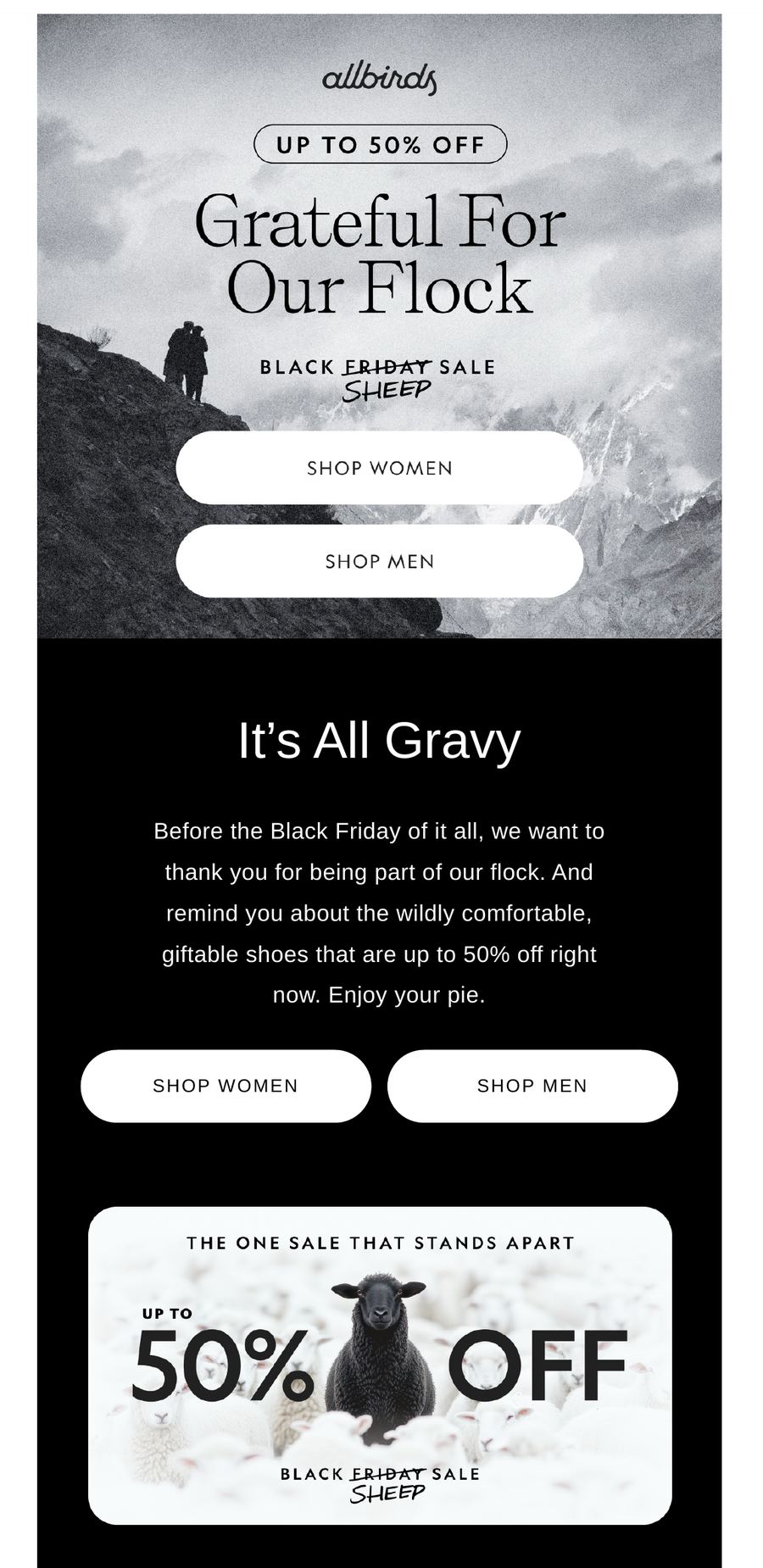
Allbirds closed November 2025 with “Grateful For Our Flock”: a thank-you and a 50% “Black Sheep” sale in the same email, ending 1 December. That is the Black Friday job, one offer and everybody shouting. Christmas starts the day after it ends. (For that part of the season, see our November email ideas, including Black Friday.)
That is why most of the sends below don’t lead with a discount. The ones that do put a date or a delivery promise next to it.
Create an Advent Calendar
Advent calendars are a creative marketing tactic to drum up sales during the holiday season. These are basically promotional bundles featuring one product per day leading up to Christmas.
Each product is packaged separately and is meant to be opened on the corresponding day.
The unwrapping is what makes this compelling because shoppers can be surprised by a new “gift” every day.

Kiehl’s turns one campaign into 24 opens. Build it once in November, it runs itself through Christmas Eve.
Ecommerce brands usually include bestsellers in their advent calendar, often in sample or mini sizes. However, some brands have a different advent calendar strategy: they offer limited-edition products to induce FOMO. This feels more exclusive as a result and adds urgency and intrigue.
Brands in SaaS or any industry that sells digital goods can also participate in advent calendars. You can release daily surprises that are downloadable or accessible through email.
Make sure to send consistent emails in the days leading up to Christmas to build anticipation and integrate social media for each day to make the surprise feel grander.
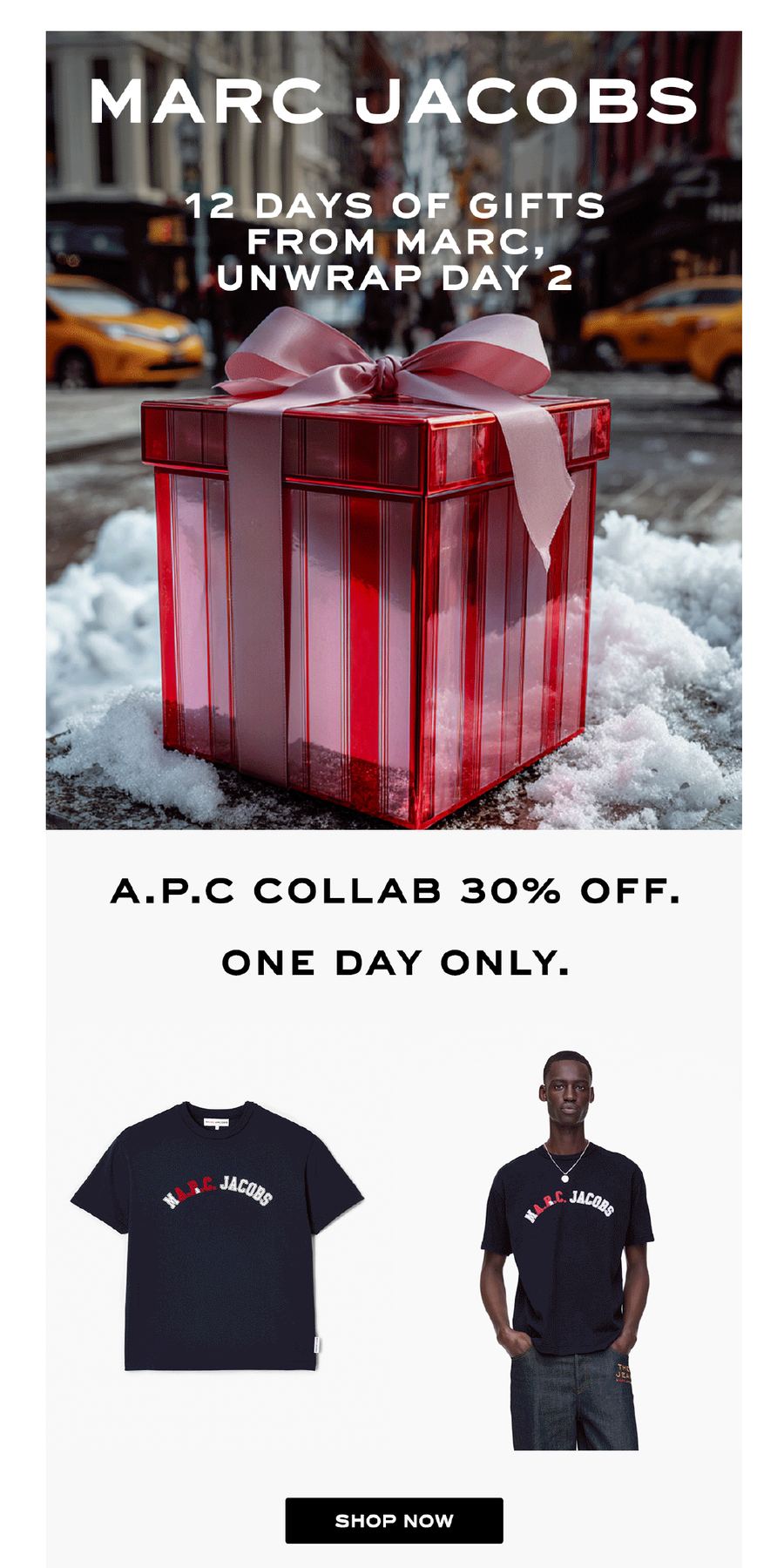
Marc Jacobs ran “12 Days of Gifts from Marc” in 2025. Day 2 was one product, one discount, one day: the A.P.C. collab at 30% off. You don’t need 24 doors. Twelve is enough, as long as each door has something behind it.
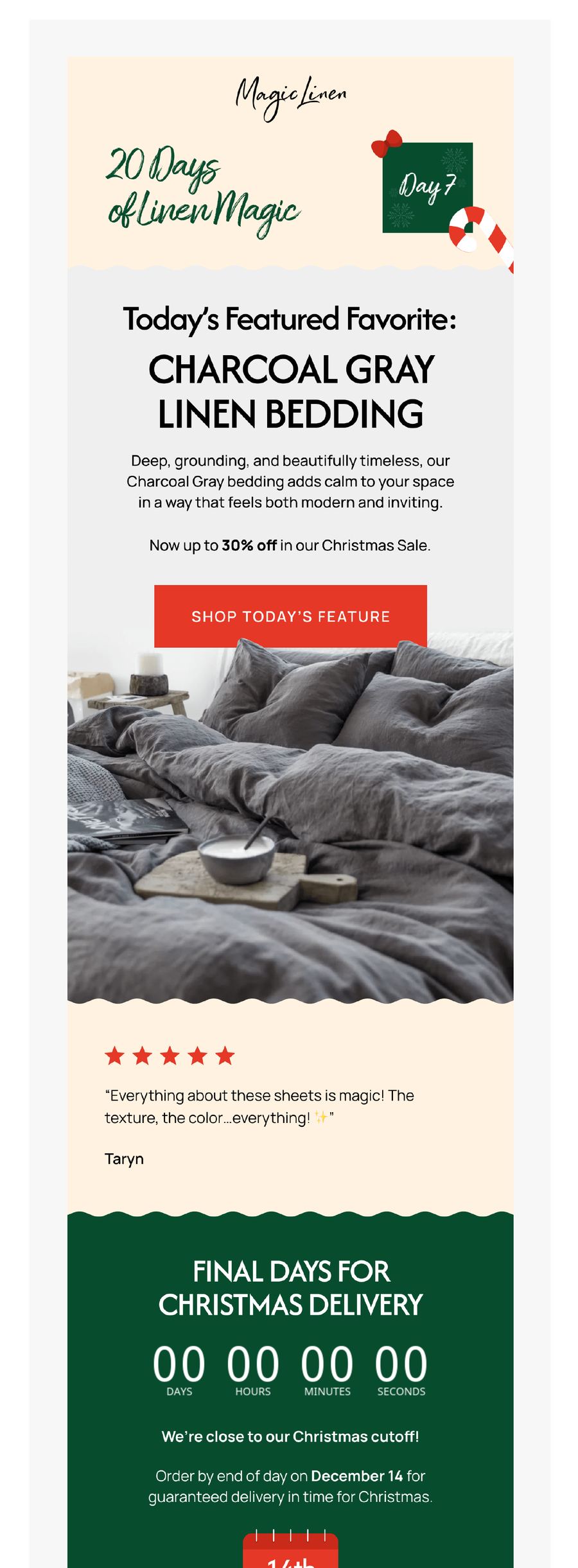
Magic Linen’s “20 Days of Linen Magic” stacks three things in one email: today’s product, a five-star review, and a countdown to the Christmas shipping cutoff (14 December). The advent door gets the open. The cutoff gets the click.
Send a Greeting Card
The holidays aren’t just about selling; it’s also about nurturing relationships with your mailing list. This way, you can really connect and stand out amongst brands that are sending transactional emails peddling discounts left and right.
Wish your subscribers a merry Christmas by sending a greeting card email. You can create designs that mimic a traditional greeting card but add your own spin such as team photos, behind-the-scenes content, or even a letter from your founder.
The email doesn’t have to be long either, just as long as it feels personal. Take inspiration from this email by Finisterre below. It’s short and expresses the founder’s gratitude.

If you really need to add a CTA, make it subtle so it doesn’t overshadow the main message of the email.
As for timing, consider sending this early in December when inboxes aren’t flooded with emails yet.

Brooklinen’s “Thank You for Sleeping With Us” is a short letter to “Partners-in-Comfort”, signed “Your friends at Brooklinen”. One button, no offer, no product grid. It sounds like a person, which is the whole point of this send.
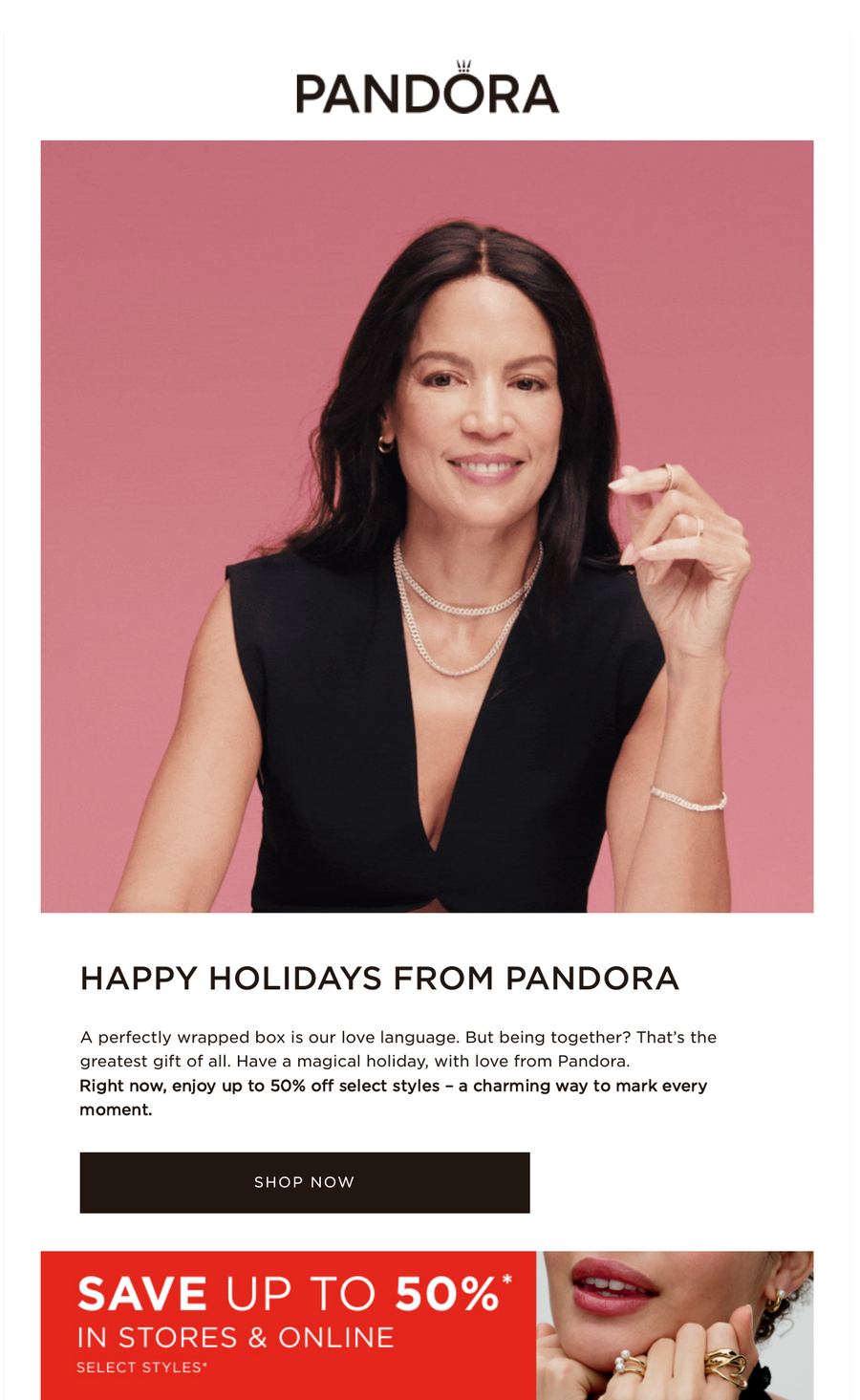
Pandora’s “Happy Holidays” opens like a card, then puts “up to 50% off” in the first paragraph and a red sale banner under it. Compare it with Brooklinen: same occasion, very different email. If you want the greeting to land, keep the offer for another send.
Curate a Gift Guide
There’s nothing like a good ol’ Christmas gift guide to get those clicks rolling in.
Aside from the major role gifts play in the holiday merriment, posting a gift guide also positions you as someone willing to help your customer give the perfect gift, rather than someone who is just out to make a sale.
It’s a double whammy because you reduce decision paralysis for the shopper while showing off your products and expertise.
A key tip for this kind of email is to categorize products per price point, such as under $25, under $50, under $100, and so on. This makes shopping even more convenient for budget-conscious customers.
Throw in gift wrapping or free shipping and you have yourself a pretty irresistible gift guide.
Wild sent this gift guide email ahead of Christmas using exactly this technique.

Posting a gift guide also positions you as someone willing to help your customer give the perfect gift, rather than someone who is just out to make a sale.
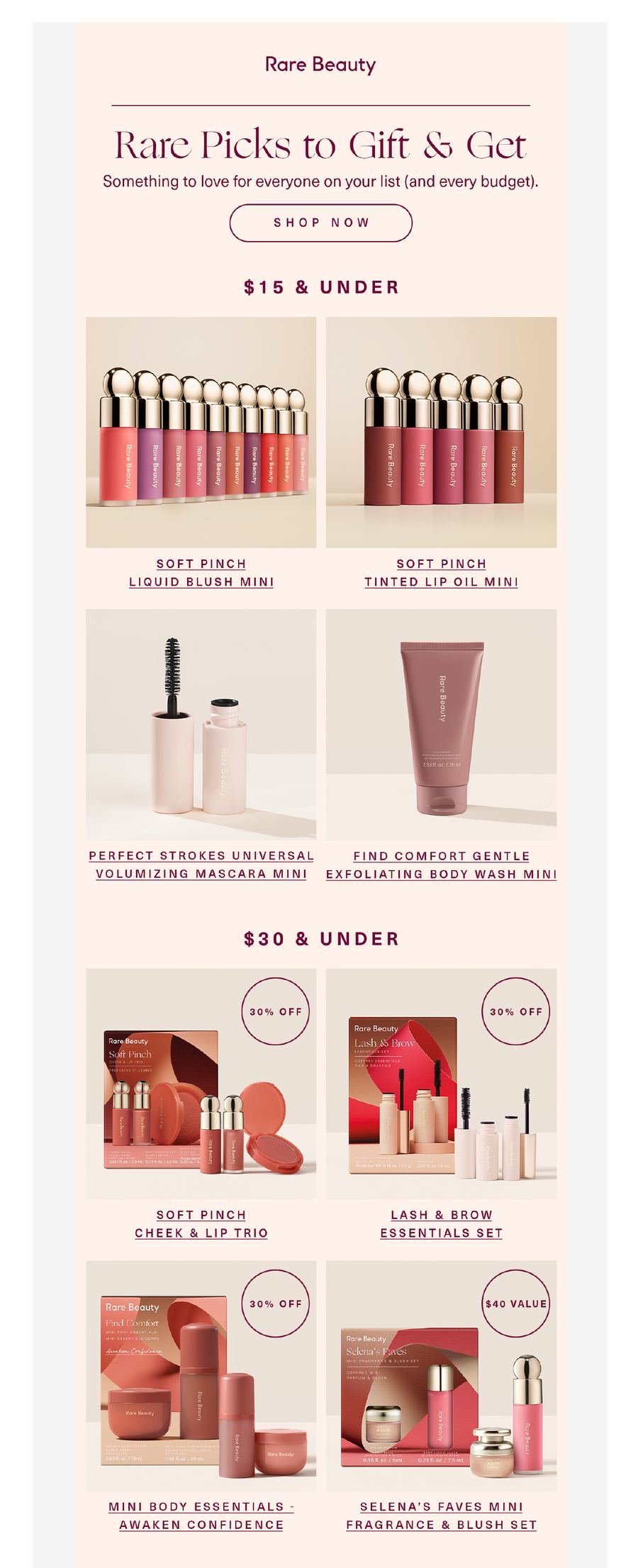
Rare Beauty sorts its guide by budget: $15 and under, $30 and under, $45 and under. The reader already knows how much they want to spend on each person. This lets them skip straight to their tier.
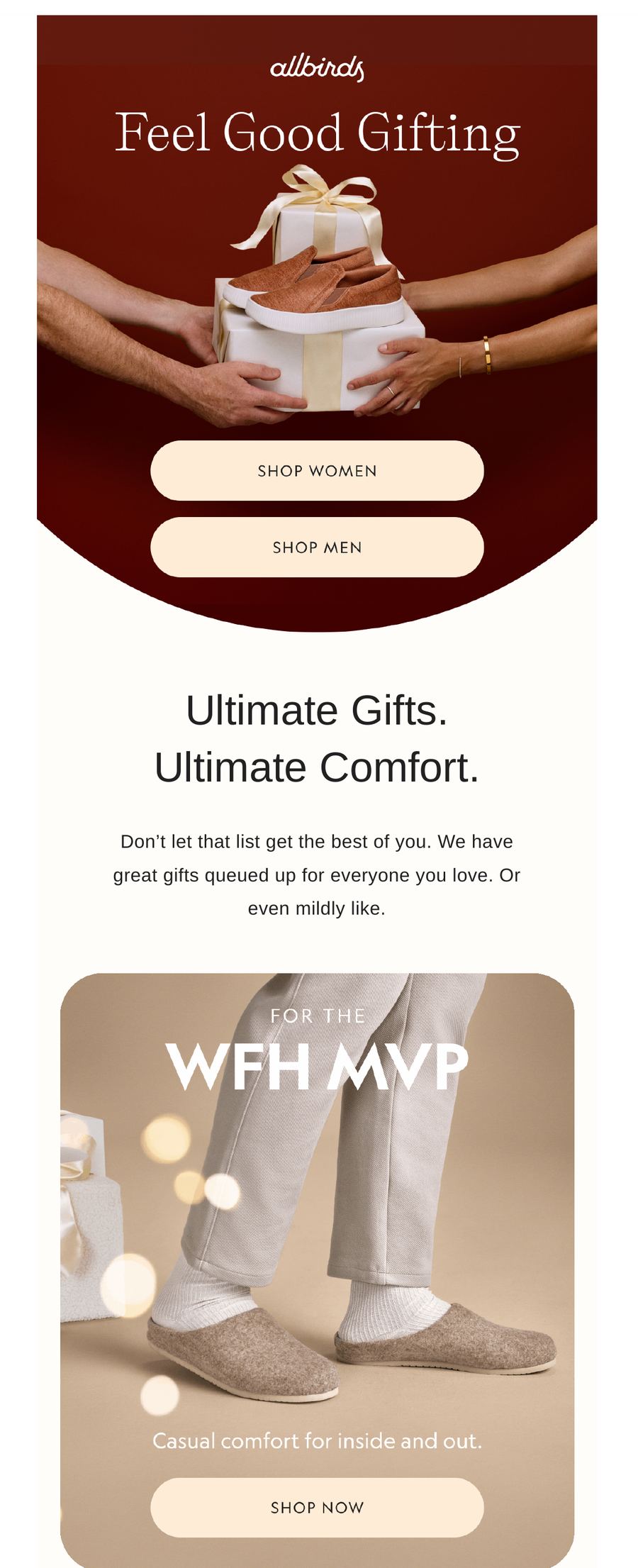
Allbirds sorts by person instead: “For the WFH MVP” and so on down the list. And the intro line, “great gifts queued up for everyone you love. Or even mildly like”, does more for the brand than any product shot.
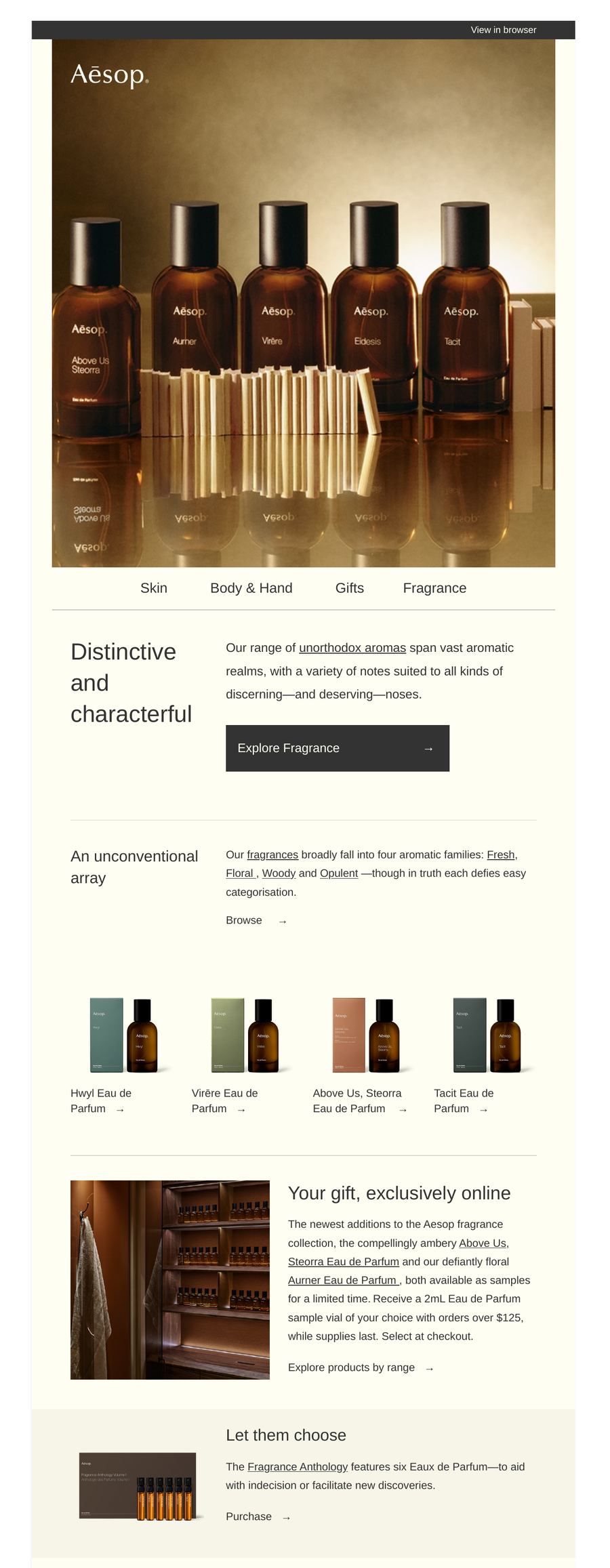
Aesop solves the hardest gift, fragrance for someone else, with a section called “Let them choose”: a six-scent anthology “to aid with indecision”. It also adds a free 2 mL sample on orders over $125, which is a reason to buy now that isn’t a discount.
Present Unique Offers and Discounts
Offers and discounts are a must-do during Christmas, but how do you take it up a notch? There are a few tricks you can use to make your promotions more lucrative.
Presenting unique offers and discounts satisfies consumer expectations for end-of-year sales but you also have to make sure you time your offers right and emphasize exclusivity.
You don’t want to make your products feel cheap during sales campaigns because you still want to maintain brand value. Aside from that, you want to create urgency so your subscribers don’t procrastinate on their purchase.
First, you can create discount stacks throughout the month. With each offer, you can add discount percentages, such as increasing discounts from ten percent to fifteen percent to twenty percent, and so on.
Flash sales (24 to 48-hour period) are also tried and true methods for creating urgency. Buy one get one (BOGO) promos also tap into the value-oriented shopper who wants to get freebies with their purchase.
Don’t forget your VIP customers. Treat them with exclusive discount tiers to show your appreciation.
For an example of how to present offers and discounts, take a look at this email from Cupshe.

They marked down all products by 30 percent and emphasized that customers can save more when they buy more. At the bottom, they also promote their new collection to make subscribers curious about their offerings.

Fenty Beauty put its discount on a specific thing, stocking stuffers, and a specific date: “Ends Dec. 19”. The line under the headline, “not too late to get them a lil’ something”, ends with “something for yourself”: permission to buy for themselves too.
More ways to frame an offer in our 40 discount and promotion ideas, and the rest of the month, Green Monday included, in our December email ideas.
Target Procrastinators
Christmas is also a high time for procrastinating. A huge percentage of people drag their feet when picking out gifts for loved ones and shop last-minute. This type of shopper is a significant segment of your audience that you need to capture.
How do you target these procrastinating customers that competitors often neglect? Simple: You just need to address their concerns in a targeted way. That means no generic promotions.
You have to create emails about the pressure of choosing gifts or the hassle of receiving packages in time for Christmas.
Here are some ways to capture revenue from this segment:
- Offer expedited shipping through “last chance” emails
- Create gift cards for gift procrastinators
- Offer digital gifts that can be given instantly to gift recipients
- Use copy that acknowledges that procrastination is real during Christmas
- Promote same-day delivery and local pickup options
Italic’s email below shows how you can reel in shoppers on a time crunch with “the gift of perfect timing”.

Notice how they create urgency with their free shipping offer. “Guaranteed December 24 delivery” is also a very persuasive part of this email because it specifies just how fast they can get the product from your cart to a customer’s doorstep.
They know how to address specific pain points effectively through this last chance email.
Last-minute email examples

Warby Parker’s headline is the whole email: “Order today, get it by 12/24”. The body says exactly which products qualify and when you need to order. Nothing else to read.

Everlane answers the question before the reader asks it: “Wondering if it’ll arrive on time? Now you know the answer is yes.” Free expedited shipping over $200 replaces the discount, then four gift tiles do the browsing for them.
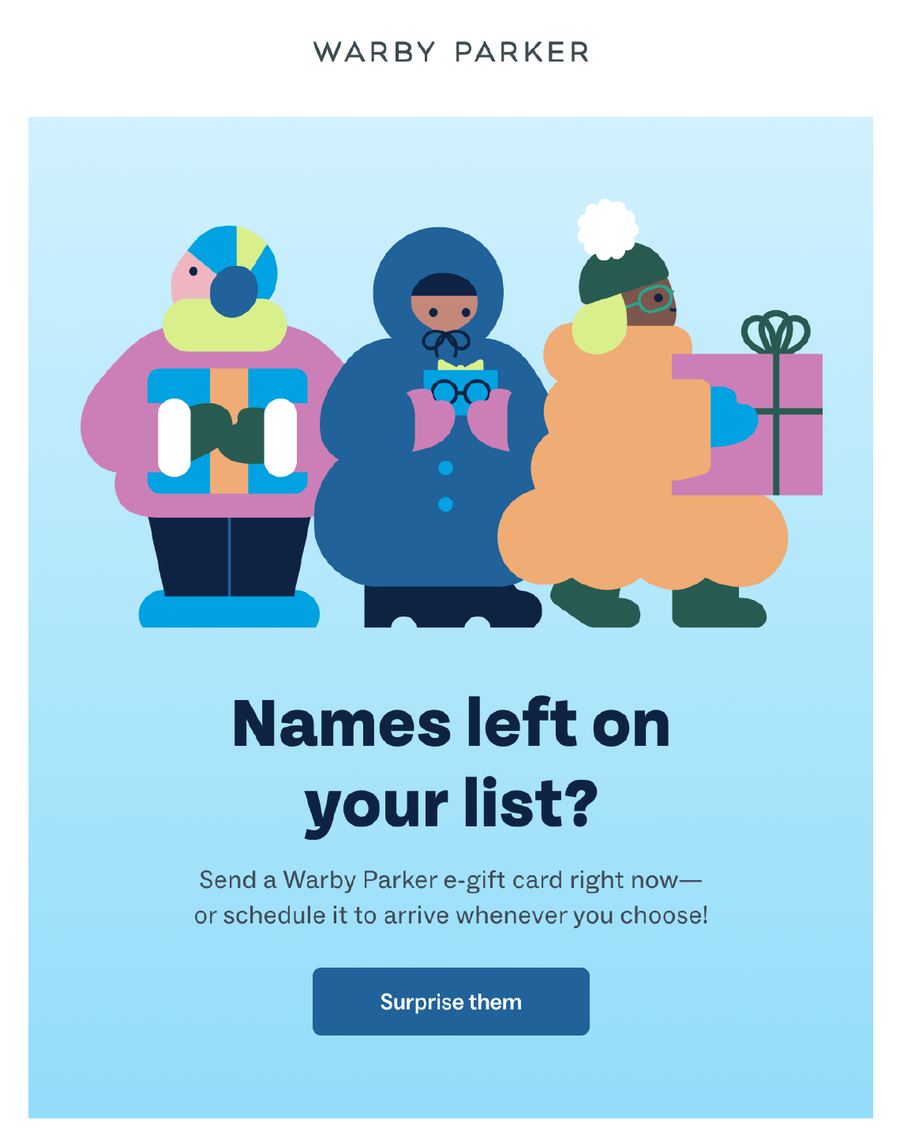
And for people who have run out of shipping days altogether, Warby Parker’s “Names left on your list?” sells an e-gift card you can send now or schedule. The deadline problem disappears.
Christmas email subject lines, by send
Fifteen subject lines you can use as they are. Three for each of the five sends above.
1. Advent calendar
- Day 1 of 24
- Open this one tomorrow too
- We hid something behind today’s door
2. Greeting card, nothing to sell
- No offer in this one
- From the eight of us
- We just wanted to say it
3. Gift guide
- Gifts for the person who says “don’t get me anything”
- Under 50, over-delivers
- We sorted them by how hard they are to buy for
4. The one real offer
- 30% off, and that is the whole email
- The sale, in one line
- This is the best price we do all year
5. The procrastinator send
- Order today, there by the 24th
- Still nothing bought? Us neither.
- Last day for Christmas delivery
Two rules behind all fifteen. No fake urgency: if it is not the last day, do not say it is. And no claim the email cannot keep: “there by the 24th” needs your carrier’s cut-off date behind it, so get that from your 3PL before you send.
The week after Christmas
Most brands go quiet on 26 December and come back on 2 January. That week is the cheapest attention of the year.
Boxing Day, Saturday 26 December 2026, is a full retail day in the UK, Canada, Australia and New Zealand. Your US list is also on their phones, with gift cards, and nothing to do.
Three sends for that week. Boxing Day, if you sell into those markets, and make it an offer rather than a greeting. A gift-card redemption email around the 28th, because that money is already yours and it expires in people’s drawers. And a New Year email on the 31st or the 1st that is about them, not about your sale.
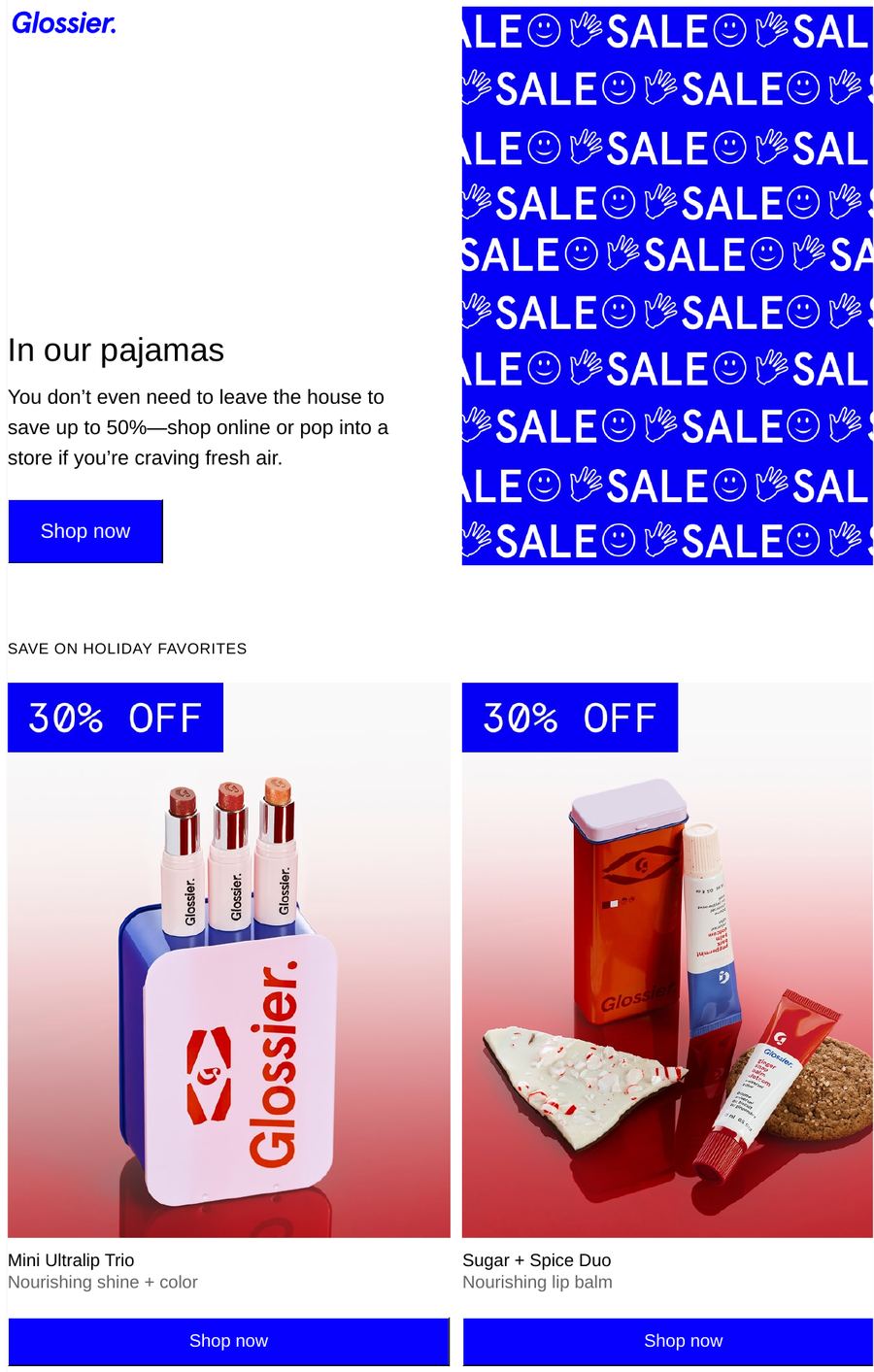
Glossier’s post-Christmas email reads like the week itself: “In our pajamas. You don’t even need to leave the house to save up to 50%.” It matches the reader’s mood instead of fighting it.
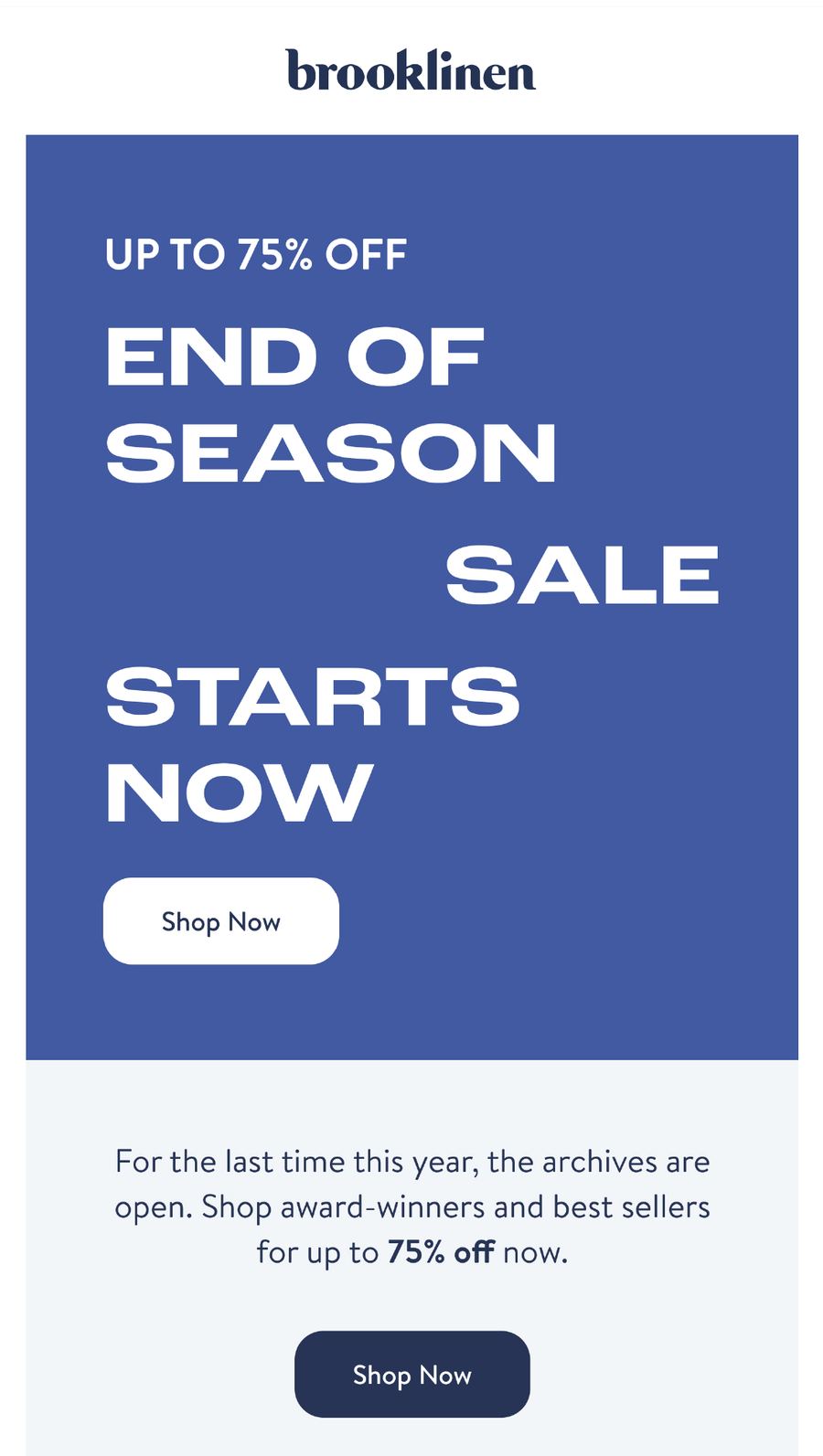
Brooklinen used the same week for its biggest number of the year: up to 75% off, framed as “for the last time this year, the archives are open”. Same brand that sent the no-offer thank-you letter above. Thank people first, sell to them in the quiet week after. That is the order to do it in.
Create better Christmas newsletters with Panoramata
That’s it for this Christmas email marketing guide. These tips and examples are brought to you by Panoramata, a one-stop shop for competitor tracking and marketing inspiration from emails to ads and landing pages.
If you’re interested in browsing more email ideas for Christmas and other holidays, sign up for free today.
Below, you can also check out our email swipe file with over 100 newsletter ideas you can use for your next campaign.
FAQs
When should I start my Christmas email campaigns?
Begin with relationship-building emails like greeting cards in early December when inboxes aren't yet oversaturated, then layer in promotional campaigns throughout the month with increasing urgency.
How can I make my discount emails stand out from competitors?
Use strategic timing to avoid overcrowded send periods, create exclusive tiers for VIP customers, and stack discounts throughout December rather than sending generic percentage-off promotions.
What's the most overlooked opportunity in Christmas email marketing?
Targeting procrastinators with last-minute solutions like expedited shipping, digital gifts, and gift cards—this segment represents significant revenue that many brands abandon in favor of early-bird promotions only.
What are some examples of holiday marketing campaigns?
This article has more than a dozen, all real. Marc Jacobs and Magic Linen ran advent calendars. Brooklinen sent a thank-you letter with nothing for sale. Rare Beauty sorted its gift guide by budget, Allbirds by recipient. Fenty Beauty put a deadline on its offer. Warby Parker and Everlane sold delivery dates instead of discounts. Different mechanics, one thing in common: each one gives the reader a reason to open that is not just a discount.
What are the marketing holidays in December 2026?
Black Friday is 27 November and Cyber Monday is 30 November, so December starts with the tail of that wave. Then: Hanukkah from 4 to 12 December, Green Monday on Monday 14 December, the last Saturday before Christmas on the 19th, Christmas Eve on Thursday the 24th, Christmas Day on Friday the 25th and Boxing Day on Saturday the 26th. More ideas for each in our 10 holiday newsletter ideas.
How many Christmas emails should I send?
Five, spread across four weeks: advent, greeting, gift guide, offer, last-minute. Most brands send one, the offer, and wonder why it underperforms. The other four are what make the offer land.
What should I send on Christmas Day itself?
Nothing you are selling. A Christmas Day send works when it has no offer in it at all, and it works best from a person rather than a brand. If your calendar has a promotion landing on 25 December, move it to the 27th.


